The story of Blackburn Cathedral stretches across more than fifteen centuries, from a reputed foundation in 596 to its consecration as a cathedral in 1977. This unassuming building in the heart of Lancashire's most famous cotton town embodies the layered history of a community transformed by industry, faith, and reinvention.
From Saxon Shrine to Parish Church
Christian worship on this site predates the Norman Conquest by several centuries. A foundation in AD 596 is claimed by John Lindley, 5th Abbot of Whalley, in his 1347 work De Statu Blagborneshire. The Domesday Book of 1086 records a church at Blackburn held by Edward the Confessor, already dedicated to St Mary the Virgin. A Norman stone church later rose on these foundations, though its remains were lost during rebuilding in the 1820s.
The medieval church that stood here served Blackburn through centuries of change. Chantry chapels funded by local families, including the Walmsleys and Osbaldestons, adorned the interior. In 1451, Thomas Stanley, 2nd Earl of Derby, established a chantry with an attached grammar school. The church survived the despoliation of Parliamentarian troops during the English Civil War in 1648. One remarkable survivor from this period is a 15th-century pax, a small devotional icon discovered in 1820 when the medieval church was demolished. It is one of only eight known surviving examples in England.
The Georgian Rebuilding
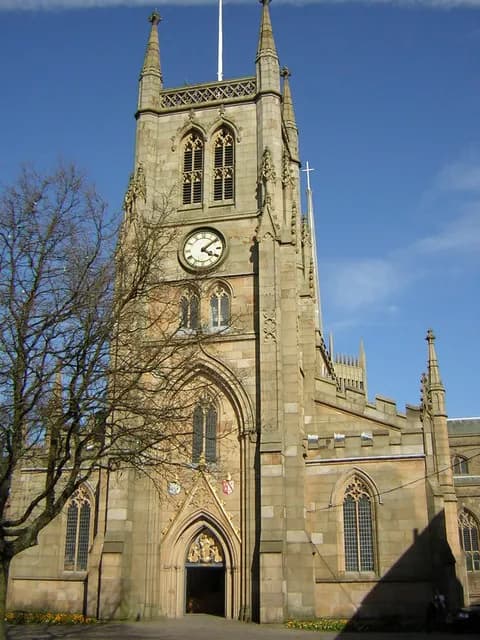
By 1818, the medieval church had fallen into disrepair. An Act of Parliament on 14 June 1819 authorised its replacement. John Palmer of Manchester designed a new church in the Gothic Revival style, constructed between 1820 and 1826. This building, with its three-stage west tower and ogee-headed arches, forms the present nave of the cathedral. A fire in 1831 damaged the structure, but restoration followed under Thomas Stones. The west tower and nave are now Grade II* listed, designated on 28 November 1951.
Cathedral Status and the Cotton Towns
The transformation from parish church to cathedral came in 1926, when the Diocese of Blackburn was founded by William Temple, then Bishop of Manchester. The new diocese was created explicitly to provide pastoral care for the expanding cotton towns of north Lancashire. Blackburn Parish Church became the seat of this new diocese, taking on a significance far beyond its modest size.
W. A. Forsyth was appointed architect in 1933 to expand the building. His ambitious plan included a large central tower, transepts, and a long chancel, while retaining Palmer's Georgian nave. Princess Mary laid the foundation stone on 7 October 1938. Work halted during the Second World War, and post-war inflation forced simplification of Forsyth's grand design.
The Lantern Tower and Completion
Laurence King took over as architect in 1961, replacing Forsyth's planned central tower with an innovative octagonal lantern tower of reinforced concrete topped by an aluminium flèche. The sanctuary was placed directly beneath this lantern, dispensing with the need for an extended eastern choir. The lantern tower was completed in 1967, and the cathedral was finally consecrated on 18 November 1977 in the presence of Princess Alexandra of Kent.
Structural problems with the original concrete lantern necessitated a rebuild between 1998 and 1999. Architect Brian Lowe reconstructed it in stone, with new abstract stained glass by Linda Walton featuring fire and water themes.
Art and Industry
The cathedral's interior holds striking artworks that connect faith with Blackburn's industrial identity. The most celebrated is Christ the Worker, a 13-foot fibreglass and aluminium sculpture by John Hayward from the 1960s. The Risen Christ wears a worker's scapular, and the mandorla behind him deliberately resembles a cotton loom, paying direct homage to the town's textile heritage.
Hayward, who served as artist-in-residence, also designed the bronze and steel Corona hanging above the altar, four gilded seraphim in the pendentives, and an egg-shaped baptismal font with bronze cover. The pulpit, carved by Advent Hunstone in 1940, depicts saints Peter, James, John the Evangelist, Mary, Andrew, and John the Baptist.
Eight 15th-century misericords from Whalley Abbey survive in the choir stalls, carved with scenes from the Garden of Eden, a fox preaching to geese, and hunting scenes. A terracotta-coloured metal Virgin and Child by Josefina de Vasconcellos dates from 1974, while The Journey by Penny Warden, fifteen paintings serving as Stations of the Cross, was added in 2005.
The stained glass includes fragments of 19th-century work rearranged by Hayward in the south transept, with remnants of an Edward Burne-Jones Faith, Hope and Charity window. The north transept holds 18th-century Flemish glass originally from the east window of the 1826 church. A complete Burne-Jones window depicting Enoch, Paul and Elijah survives in the ambulatory.
Millennium and Modernity
The cathedral continues to evolve. The Healing of The Nations, an eight-metre steel and copper disk with fibre optics by Mark Jalland, was unveiled in 2001. In 2009, a new flagpole topped with a carved mitre, funded by a bequest from cathedral warden Harold Thornber and created by Mark Bridges, was installed.
On 17 April 2014, Queen Elizabeth II attended the Royal Maundy service at the cathedral, distributing Maundy coins to 88 men and 88 women. The occasion marked only the second time the ceremony had been held in Lancashire.
The most significant recent development is Cathedral Court, completed in 2016 after a sixteen-year, £36 million project. This regeneration scheme created new cloisters, the first in a UK cathedral since the 16th century, along with a library, refectory, offices, residences, public square, hotel, and office space. The project reconnected the historic building with Blackburn town centre.
During the COVID-19 pandemic in 2021, the cathedral crypt served as a major public vaccination centre, demonstrating its continuing role as a community resource.
Today
Blackburn Cathedral remains open to visitors daily except Monday. The crypt houses "Checks and Greys" café, named after the cathedral's distinctive exterior patterning. Regular services include Parish Communion, Eucharist, and Evensong sung by the cathedral's choirs. The building hosts concerts, recitals, and exhibitions throughout the year.
As the seat of the Diocese of Blackburn, it serves 235 parishes across Lancashire. The Very Revd Peter Howell-Jones serves as Dean, while the current Bishop is Philip North. From its disputed Saxon origins through the Georgian rebuilding, the wartime interruptions, and the 21st-century regeneration, the cathedral stands as a monument to faith that has adapted to serve a town shaped by cotton, commerce, and community.