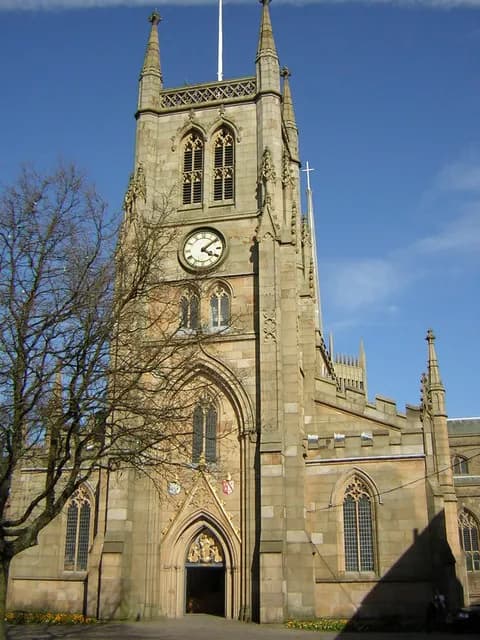
Blackburn Cathedral stands as a defining landmark in the town centre, its tower visible from across the surrounding area. The building has served the community through periods of profound change, from the height of the cotton industry to the present day.
From Parish Church to Cathedral
The building's origins stretch back centuries as a parish church dedicated to Saint Mary the Virgin. Its transformation into a cathedral came in 1926, when the Diocese of Blackburn was created. This change reflected the town's importance within the Church of England's administrative structure and marked a new chapter in the building's role.
The cathedral's full official name, the Cathedral Church of Blackburn Saint Mary the Virgin with St Paul, acknowledges both this history and the broader ecclesiastical tradition it represents.
The Tower: A Later Addition
The most visible element of the cathedral, its tower, was not completed until 1967. This makes it a relatively recent addition to a building with much older foundations. The tower's construction spans four decades of the twentieth century and represents the cathedral's continued development long after its initial elevation to cathedral status.
Photographs from before this date show the building without its now-familiar silhouette. The completed tower fundamentally altered how the cathedral presents itself within the town's skyline.
Architecture and Setting
The cathedral occupies a prominent position in Blackburn town centre. Its architecture combines elements from different periods, reflecting the various phases of construction and modification that have taken place over its history.
The building serves both religious and community functions. As the seat of the Bishop of Blackburn, it remains an active place of worship. It also functions as a venue for civic events, concerts, and other gatherings that bring together residents from across the town.
Local Significance
For residents, the cathedral provides a constant physical reference point within the town. Its presence connects contemporary Blackburn to earlier generations who also used the building for worship, ceremony, and community events.
The structure holds particular relevance for those interested in local history and architecture. Its evolution from parish church to cathedral, and the later addition of the tower, illustrate how Blackburn has changed and developed over the past century.
Visiting the Cathedral
The cathedral is open to visitors and worshippers. Its central location makes it accessible to those exploring the town centre, whether for religious purposes or to appreciate its historical and architectural significance.
Services continue to be held regularly, maintaining the building's primary function as a place of Anglican worship for the Diocese of Blackburn.