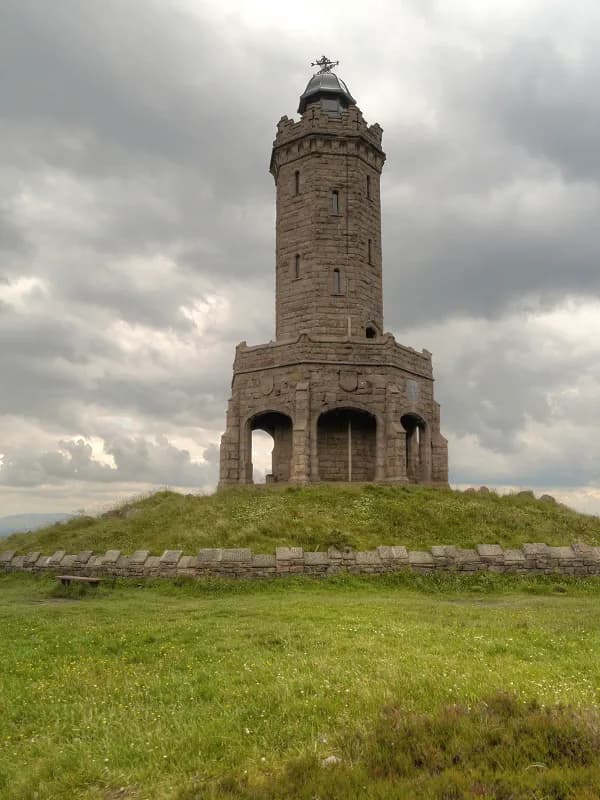
The octagonal stone tower overlooking Blackburn and Darwen stands as both a monument to Queen Victoria's Diamond Jubilee and a testament to one of the earliest victories in Britain's right to roam movement. Its construction in 1898 marked the end of an 18-year struggle that pitted working-class townspeople against an absentee aristocratic landlord.
The Battle for Darwen Moor
The conflict began in the 1870s when Reverend William Arthur Duckworth, Lord of the Manor of Over Darwen, began blocking ancient rights of way across the moorland. Duckworth, who lived at Orchardleigh in Somerset and owned the manor from 1859, had lucrative game-shooting rights on the land and sought to exclude the public entirely.
Leading the resistance was William Thomas Ashton, a mine manager at Eccles Shorrock's collieries at Dogshaw Clough and Entwistle Moss. Born in Blackburn in 1832, Ashton used the moorland footpaths to deliver coal to local farmers. Whenever gamekeepers blocked the paths, Ashton cleared them; when substantial barriers were erected, he used a saw to remove them. Ashton was one of five main resisters, alongside three labourers, a gardener, and a mason.
The battle lasted 18 years, from approximately 1878 to 1896, and involved what contemporary accounts described as "bloody skirmishes, lawsuits and protracted negotiations." Duckworth and his shooting rights lessee, Mr. Ashworth, fought the campaigners through the courts, but local resistance remained unwavering.
Victory and the Great Assembly
The breakthrough came in September 1896, when a compromise was reached. Nearly 300 acres of moorland passed into public possession, granting the people of Blackburn and Darwen the right to roam the hills above their towns.
On 7 September 1896, an estimated 15,000 people assembled for the moorland handover ceremony. The procession included the Town Council, friendly and trade societies, police and fire brigades, Blackburn and Darwen Volunteers, and six brass bands. Ashton's three sons led the celebratory procession; Ashton himself had died in 1894, two years before witnessing the victory he had done so much to secure.
After the council formally took possession of the moors, a bonfire was lit and a fireworks display marked the occasion. The Manchester Courier reported on the celebrations, noting the scale of public feeling behind the access campaign.
Building the Tower
With the moorland victory secured, attention turned to commemorating both the Jubilee and the access triumph. At a town meeting in 1897, Robert Shorrock, chairman of the parks committee, proposed erecting a tower on the moor. The idea captured the public imagination, and a design competition was held. David Ellison, an employee of the borough surveyor's office, won the competition, though borough surveyor Robert William Smith-Saville modified the design before construction.
Public subscription raised over £1,500, with £650 devoted to a nursing association. Local builder James Whalley won the construction tender with a bid of £773 3s 5d. The stone was donated by Reverend Duckworth himself, who reportedly claimed ignorance of the access fight during his speech at the opening ceremony.
The foundation stone was laid on 22 June 1897, Queen Victoria's Diamond Jubilee day, by Alexander Carus Esq., J.P., the Mayor of Darwen. The tower opened to the public on 24 September 1898, with the Reverend W.A. Duckworth performing the opening ceremony before a crowd of 3,000 people.
A Structure of Significance
The tower rises 85 feet (26 metres) in an octagonal plan, with a staircase leading to viewing platforms. An eastern plaque records its dual purpose: "1897 THIS TOWER Was erected... out of the public subscriptions raised to commemorate the DIAMOND JUBILEE of the reign of HER MAJESTY QUEEN VICTORIA." The structure also stands as an unspoken monument to the working-class campaigners who fought for access to their local landscape.
The Darwen Moors victory predates the more famous 1932 Kinder Scout mass trespass by 36 years, making it an early landmark in the fight for public access to the British countryside. Unlike the Kinder Scout trespassers, several of whom were imprisoned, the Blackburn and Darwen campaigners achieved their goal through sustained legal and political pressure.
Preservation and Restoration
The tower has faced numerous threats over the decades. During the Second World War, it narrowly escaped demolition after the authorities classified it as a hazard to low-flying aircraft; American buyers even offered to purchase it and relocate it to the United States. In 1947, gales caused significant damage. The tower was Grade II listed in 1972, and Mayor Bill Lees led a restoration campaign in 1971.
More recently, the tower's distinctive dome has been replaced twice. Storms in 2010 damaged the structure, and a new powder-coated stainless steel dome, manufactured by WEC Group of Darwen, was winched into place by helicopter on 13 January 2012 at a cost of over £35,000.
Between 2021 and 2022, a major restoration project secured £300,000 in funding, including £250,000 from central government and additional funds raised by the local Rotary Club, who displayed a Lego model of the tower in Darwen Market Hall. In June 2022, the tower was illuminated to celebrate Queen Elizabeth II's Platinum Jubilee.
Today
Blackburn with Darwen Borough Council now owns and manages both the tower and the moor. Darwen Town Council, formed in April 2009, represents local interests. The tower remains open to the public, offering views across Lancashire to the Welsh hills and the Isle of Man on clear days.
The structure continues to symbolise how organised local resistance can prevail against wealthy landowners. For the people of Blackburn and Darwen, the tower represents not only loyalty to crown and country, but the fundamental right to walk the hills above their homes.